Winning Strategies for 2 Suit Spider Solitaire: Expert Guide to Boost Your Win Rate
Master 2 Suit Spider Solitaire with proven winning strategies. Learn card sequencing, empty column tactics, King management, and avoid common mistakes. Includes probability analysis and expert tips for 15-20% win rates.
What Is 2 Suit Spider Solitaire?
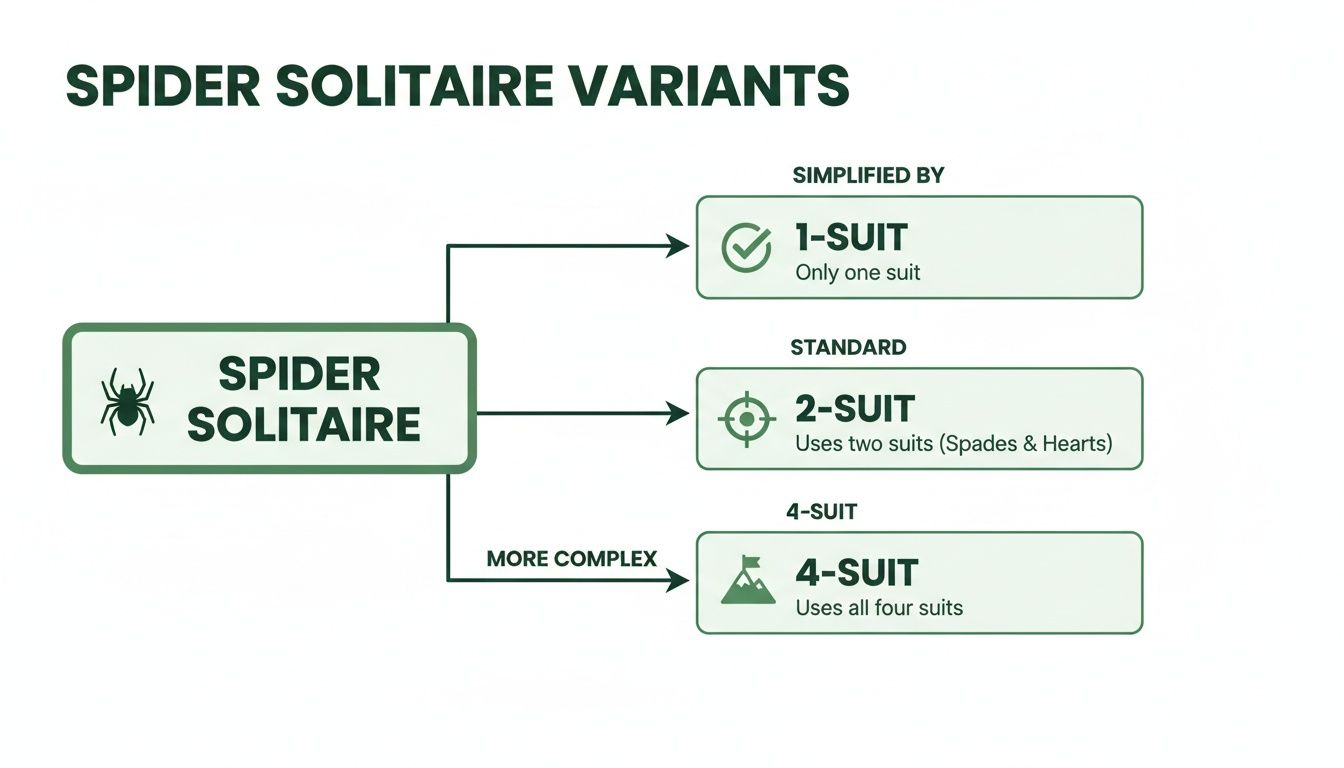
2 Suit Spider Solitaire is a challenging card game that uses two complete decks (104 cards) with only two suits—typically Hearts and Spades. Part of the Spider solitaire family, this variant sits between the easier one-suit version and the notoriously difficult four-suit version, offering the ideal balance between skill and solvability.
The objective is straightforward: build eight complete sequences from King down to Ace, each in a single suit. When a full descending sequence is formed (K-Q-J-10-9-8-7-6-5-4-3-2-A of the same suit), it automatically moves to the foundation.
This guide provides proven winning strategies for 2 Suit Spider Solitaire that can raise your win rate from the average 10-12% to a consistent 16-20%.
Ready to Apply These Strategies?
Start a free game on Pixel Solitaire and practice what you learn in this guide.
Why Choose 2 Suit Spider Over Other Variants?
The Strategic Sweet Spot
One-suit Spider Solitaire is often too forgiving—most games are winnable even with suboptimal play. Four-suit Spider sits at the opposite extreme, where even perfect decisions can fail due to unfavorable card distribution.
Two-suit Spider Solitaire occupies the strategic sweet spot where:
- Skill consistently beats luck over many games
- Poor decisions compound into losing positions
- Good decisions create genuine advantages
- The learning curve rewards dedicated practice
Skill vs. Luck Analysis
In 2 Suit Spider Solitaire, approximately 70% of your outcomes depend on strategy, while only 30% comes from the initial card distribution. Compare this to:
- One-suit Spider: ~40% skill, 60% favorable deals
- Four-suit Spider: ~50% skill, 50% luck (many unwinnable deals)
This ratio makes 2 Suit Spider the best variant for players who want their improvement to show in measurable results.
Spider Solitaire Difficulty Comparison
| Variant | Suits Used | Difficulty Level | Average Win Rate | Strategic Depth |
|---|---|---|---|---|
| 1 Suit Spider | Spades only | Beginner | 75-85% | Low |
| 2 Suit Spider | Hearts + Spades | Intermediate | 15-20% | High |
| 4 Suit Spider | All four | Expert | 5-10% | Extreme |
A 16-18% win rate in 2 Suit Spider indicates strong play. Anything above 20% suggests exceptional strategic understanding.
Complete Rules and Setup
Initial Layout
The game begins with:
- 104 cards (two complete decks, two suits only)
- 10 tableau columns arranged as follows:
- 4 columns with 6 cards each
- 6 columns with 5 cards each
- Only the top card of each column is face-up
- 50 remaining cards form the stock pile (5 deals of 10 cards)
Movement Rules Summary
Understanding the movement rules is essential for strategic play:
- Any card can be placed on a card one rank higher, regardless of suit
- Only same-suit sequences can be moved together as a unit
- Empty columns can accept any card or valid same-suit sequence
- Stock deals require all columns to be filled (no empty columns allowed)
- Complete K-to-A sequences (same suit) are automatically removed
| Action | Where | Key Rule |
|---|---|---|
| Stack cards | Tableau | Place on one rank higher (any suit) |
| Move sequence | Tableau | Same-suit sequences only move together |
| Fill empty column | Tableau | Any card or same-suit sequence |
| Deal from stock | Stock | All 10 columns must have cards |
| Complete sequence | Foundation | K→A same suit auto-removes |
For the complete rulebook, see our Spider Solitaire guide.
Core Winning Strategies

1. Prioritize Revealing Hidden Cards
Face-down cards are your primary obstacle. Every hidden card:
- Reduces available information
- Limits strategic options
- May contain critical cards (Kings, Aces)
The fundamental principle:
A move that reveals a new face-down card is almost always better than a move that only rearranges visible cards.
Even if uncovering creates temporary disorder, the information gained typically outweighs short-term complications.
2. Build Same-Suit Sequences from the Start
Same-suit sequences are the foundation of winning play. They provide:
- Mobility: Entire sequences move as one unit
- Flexibility: Easy board reorganization
- Progress: Only same-suit sequences complete the game
Mixed-suit stacks should only serve as temporary tools to access hidden cards—never as permanent structures.
3. Protect and Create Empty Columns
An empty column is your most valuable resource. It functions as:
- A holding area for Kings
- A dismantling zone for mixed-suit stacks
- Temporary storage during complex reorganizations
Strategic priority: If you can create an empty column without major sacrifice, do it. The tactical flexibility is worth more than keeping cards superficially organized.
4. Delay Stock Deals as Long as Possible
Each stock deal adds 10 new cards simultaneously, which typically increases complexity rather than solving problems.
Before dealing from stock:
- Exhaust every possible tableau move
- Clean up or minimize mixed-suit stacks
- Verify no column can be emptied
- Ensure you've revealed maximum hidden cards
Premature stock deals cause more losses than any other single mistake.
Practice Delayed Stock Deals
The single most effective habit change: only deal when truly stuck. Practice this in your next game.
Advanced Strategic Techniques
Managing Mixed-Suit Sequences
Sometimes building mixed-suit stacks is unavoidable—but every mixed stack is strategic debt.
When mixing suits is acceptable:
- It reveals a hidden card with no alternative
- The stack is short (3-4 cards maximum)
- You have a clear plan to dismantle it later
When to avoid mixing suits:
- Kings or Queens would be buried
- No immediate benefit (just "tidying up")
- You're already carrying too much strategic debt
Think of mixed-suit stacks as loans: sometimes necessary, always costly, and you must pay them back eventually.
King Management Strategy
Kings are immovable once placed—they can only go into empty columns. A buried King can freeze an entire column permanently.
Effective King management:
- Track King locations: Always know where Kings are, face-up or hidden
- Preserve empty columns for Kings: Don't fill empties casually
- Move exposed Kings immediately: An exposed King in a short column wastes that column
- Uncover Kings early: If you suspect a King is hidden, prioritize that column
The "Superstack" Technique
A superstack is an extended same-suit sequence (8+ cards) that gives you massive reorganization power. Building superstacks should be a mid-game priority.
How to build superstacks:
- Identify your longest same-suit sequence
- Feed it cards of the same suit when possible
- Protect it from being blocked by Kings
- Use it to "vacuum" cards from messy columns
A superstack of 10-11 cards can single-handedly rescue a difficult game.
Reading the Tableau
Before every move, scan the entire tableau for:
- Exposed Aces: These are endpoints—plan sequences backward from them
- Buried Kings: These columns may become frozen
- Long same-suit sequences: Potential superstacks
- Columns with many face-down cards: Priority targets
Developing this "board reading" habit separates intermediate players from experts.
Probability and Statistics
Like many patience games, Spider Solitaire involves elements of both skill and chance. Understanding the mathematics helps set realistic expectations.
Why the Win Rate Matters
- Random play: ~3-5% win rate
- Basic strategy: ~10-12% win rate
- Intermediate strategy: ~15-18% win rate
- Expert strategy: ~20-25% win rate
Each strategic principle in this guide can add 1-3 percentage points to your win rate.
Card Distribution Probabilities
In 2 Suit Spider Solitaire:
- 52 cards per suit (two complete sets of Hearts, two of Spades)
- 4 copies of each rank exist (e.g., four Kings of Hearts)
- Probability of a specific card being face-down: Approximately 48% at game start
This redundancy (multiple copies of each card) is why 2 Suit Spider is more forgiving than 4 Suit—if one King of Hearts is buried, another may be accessible.
Estimating Winnability
Experienced players can often estimate a game's winnability within the first 2-3 stock deals:
| Indicator | Good Sign | Bad Sign |
|---|---|---|
| Kings exposed | 2+ visible early | Multiple Kings buried |
| Empty columns | Achievable by stock 2 | Still impossible at stock 3 |
| Same-suit runs | 6+ card sequences forming | Only 2-3 card fragments |
| Mixed stacks | Minimal, dismantleable | Deep, with buried cards |
When a game shows multiple bad signs, consider whether investing further time is worthwhile.
Common Mistakes and How to Fix Them
Mistake 1: Dealing from Stock Too Early
The problem: Adding 10 cards before the tableau is optimized creates cascading complications.
The fix: Make dealing your last resort. Ask yourself: "Have I truly exhausted every move, every empty column opportunity, every possible card reveal?"
Mistake 2: Filling Empty Columns Carelessly
The problem: Placing non-King cards in empty columns wastes your most valuable resource.
The fix: Before filling an empty column, verify:
- Is there a King that needs placement?
- Will I regret not having this empty space in 3-4 moves?
- Am I filling it for a tangible benefit or just to "use" it?
Mistake 3: Creating Deep Mixed-Suit Stacks
The problem: Mixed stacks longer than 4-5 cards become nearly impossible to dismantle.
The fix: If you must mix suits, keep it shallow. Never bury Kings or Queens in mixed stacks. Always have a mental exit strategy.
Mistake 4: Ignoring Buried Kings
The problem: A King buried under 4+ cards will freeze that column for most of the game.
The fix: If you identify a probable buried King, make uncovering it a priority—even if it means suboptimal moves elsewhere.
Mistake 5: Completing Sequences Too Early
The problem: Sending a K-to-A sequence to the foundation removes those cards permanently. Sometimes you needed them.
The fix: Keep completed sequences on the tableau if:
- They're not blocking anything
- You might need their cards for other columns
- The game isn't yet under control
Test Your Understanding
The best way to internalize these strategies is through deliberate practice. Start a game and consciously apply each principle.
Using Undo as a Training Tool
The undo feature isn't cheating—it's your most powerful learning accelerator.
How to Practice with Undo
- Make your best guess for each move
- Execute and observe the consequences
- Undo if necessary and try alternatives
- Compare outcomes between different move choices
- Remember the pattern for future games
This deliberate practice develops pattern recognition faster than playing games start-to-finish.
What to Look for When Exploring
When using undo to explore:
- Which move reveals the most useful card?
- Does this move create or destroy empty column opportunities?
- Am I building strategic debt (mixed stacks) for sufficient payoff?
- Will this move help in 5 turns, or only right now?
Quick Reference: Strategy Checklist
Use this checklist during games:
Before every move:
- Can I reveal a hidden card?
- Can I build a same-suit sequence?
- Can I create or preserve an empty column?
- Am I creating unnecessary mixed-suit debt?
Before dealing from stock:
- Have I made every possible move?
- Are all columns filled (required)?
- Is my tableau as clean as possible?
- Have I revealed maximum hidden cards?
When stuck:
- Check for Kings that need empty columns
- Look for superstacks that can reorganize
- Consider whether this game is still winnable
Frequently Asked Questions
What is a good win rate for 2 Suit Spider Solitaire?
A 16-18% win rate indicates strong play. Beginners typically win 8-10% of games, while experts can reach 20-25%. Unlike simpler solitaire games, even perfect play cannot win every deal—approximately 1 in 5 games with optimal strategy is the realistic ceiling.
How long does a typical game take?
Average game duration is 10-15 minutes for experienced players. Difficult games requiring many undo explorations can take 20-30 minutes. Speed improves naturally with pattern recognition.
Should I ever build mixed-suit sequences?
Yes, but strategically. Mix suits only when it reveals hidden cards, keep mixed stacks short (under 5 cards), never bury Kings or Queens, and always have a dismantling plan.
When should I deal from the stock pile?
Only when no other legal moves exist and all tableau columns contain at least one card. Premature dealing is the most common cause of losing winnable games.
Is 2 Suit Spider harder than Klondike Solitaire?
Yes, significantly. Klondike Solitaire has win rates around 80% with decent play. Two Suit Spider's 15-20% win rate reflects genuinely higher difficulty. However, Spider rewards skill more consistently.
Why can't I move my sequence?
Sequences can only move as a unit if every card is the same suit. A run like K♠-Q♥-J♠ looks connected but cannot move together because it contains mixed suits.
Start Playing 2 Suit Spider Solitaire
You now have a complete strategic framework for improving at 2 Suit Spider Solitaire. The key principles are:
- Reveal hidden cards before anything else
- Build same-suit sequences as your primary goal
- Protect empty columns as your most valuable resource
- Delay stock deals until absolutely necessary
- Use undo to accelerate your learning
Put Your Knowledge Into Practice
Free, instant play in your browser. No download required. Track your improvement over multiple sessions.
Related Games
Looking for more card game challenges?
- Easier: Spider Solitaire - One Suit — Perfect for learning Spider basics
- Harder: Spider Solitaire - Four Suits — The ultimate Spider challenge
- Different style: Klondike Solitaire — The classic solitaire everyone knows